
by Kristianne Drake
Throughout history women have been more synonymous with photography as the subject-matter or object rather than the maker. And it is for this reason that the significance of women photographers is important. They have disrupted and challenged the conventional notions of spectatorship by shifting their position.
I want to share with you a few (but for me important) names who have shaped my understanding and making of photographic images over the years.
The photograph that kicked off my career change into the world of photography is imprinted into my brain as clear as the day I first saw it. I was 31, and just beginning living life as a single mum of one on a day out at the Tate Modern.
When leaving through the shop I came across a postcard that spoke to me, drawn in by the beautiful soft golden light and the strangely sad but beautiful composition of these two figures in a room, both on a bed facing away from each other, as if a moment of intimacy has passed but we don’t really know what. I didn’t know who these people were, or why they were there, or who or how that image had been made, but I bought it and took it home. I put it up on the wall and soaked it up every day not thinking to find out more or look into who had made it until I enrolled on an A level photography course and was asked to bring in the image that had brought me to that point.
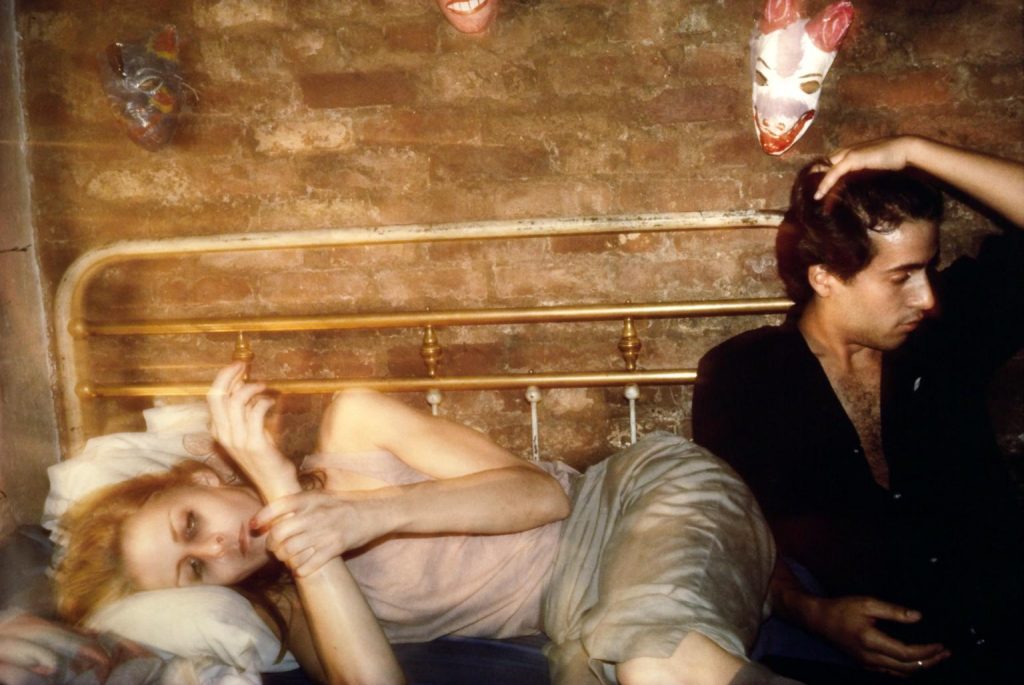
Nan Goldin: Greer and Robert on the bed, NYC 1982
Over the next couple of years, I soaked up every piece of Nan Goldin work I could find. I bought books and saw the retrospective of her work at the Whitechapel Gallery. How could something as vernacular as friends hanging out be such stimulating material (and why hadn’t I seen it before?). I had bought myself a cheap 35mm camera and was shooting roll after roll of film whilst learning how to process and print one evening a week. Fast forward 2 years and I had enrolled on a photography undergraduate degree programme where my hunger for new photographers was fed. Two more key influences in my work were introduced to me; Francesca Woodman and Mona Hatoum (I know not strictly a photographer but uses the medium).
Again, I fell in love with the work of Francesca Woodman before I knew the story behind it. How she used the same subject (herself) over and over again because she knew it the best, and she could make it do what she wanted. I connected with the key components she used to make work; repetition and time. It never felt sad to me, but playful composed with a strangely disconnected energy that sang of sorrow and joy and love all mixed up like a ball of thread that has fallen and tangled.
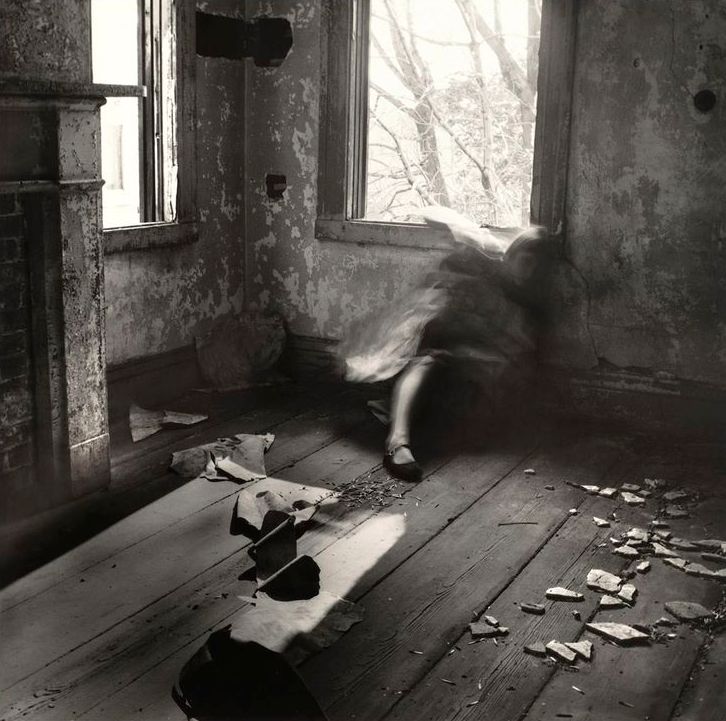
Francesca Woodman, House #3, Providence, Rhode Island, 1976
The work of Mona Hatoum was again different. It engaged me in a way I hadn’t ever considered before. That no one artistic medium lives in a vacuum and everything has an affect or effect on everything else. Hatoum layered photographic image with text and sound and liberated me (I felt I needed the ‘permission’) to engage with photography in a way that I hadn’t previously seen before. Through installation, video and storytelling and the immortalisation of sculptural works in photographic book form (something the performance artist Marina Abramovic also does and who I have also been influenced by).
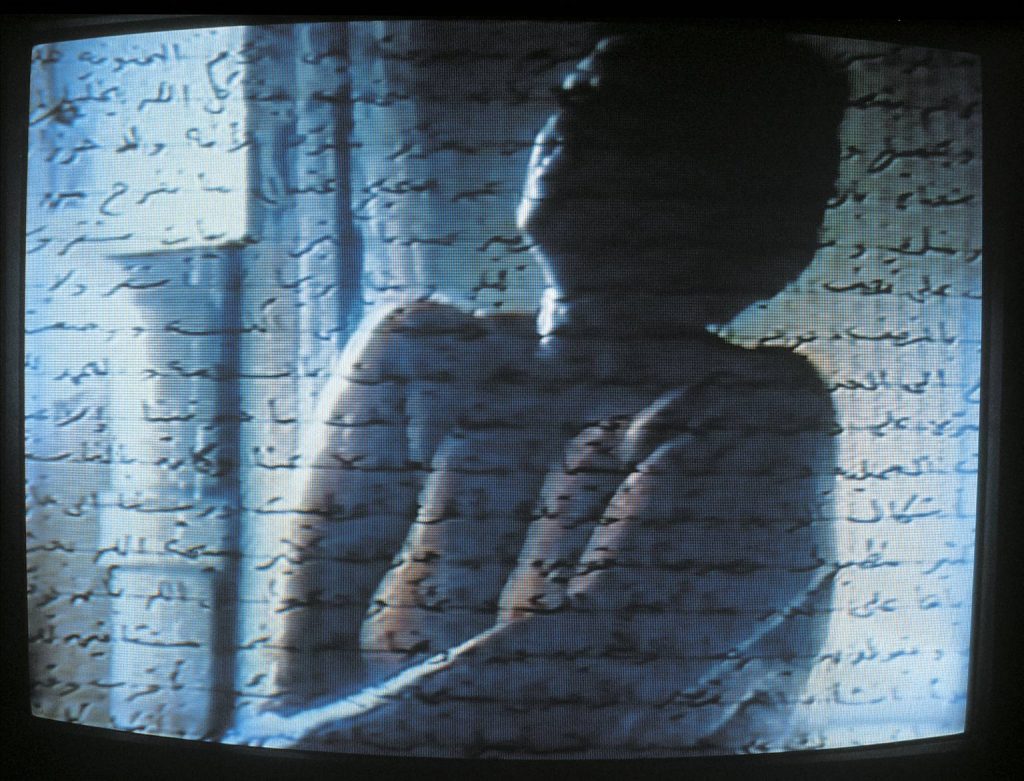
Mona Hatoum: Measures of Distance, 1988
When most people think about photography There are a few big names in the world that most people recognise, and they are largely male. The females are always the muse – Lee Miller who was in fact an incredible war photographer, or, when they do break that male threshold they evoke criticism; think Annie Lebovitz and the portraits she made of Queen Elizabeth II or Miley Cyrus; think Diane Arbus photographing the ‘marginalised’ people, or Mary Ellen Mark documenting the Damm Family or Sally Mann’s photographs of her children; none of them receiving the same level of accolades that their male counterparts do in recognition of their work. And yet the importance of their work cannot be brushed aside and disregarded because they brought a different viewpoint to the lens. They showed us another way to see what we could see from a more feminine viewpoint.
There are of course male photographers that have influenced the way I make a photograph now, I’d be a liar to say otherwise. But today I want you to celebrate the names above. Go away and discover their magic if you don’t know them. See in a different light (literally) through the lens of some of the most amazing photographers.
I asked my co-workers at In Focus to share with me the women photographers who have been influential in their work and this is who they shared:
Ben Cowley:
Imogen Cunningham
What I find most interesting and exciting about her work is not necessarily the photographs themselves, but the spirit of how she makes her photography and the thought behind them.
By all accounts of the people who knew and worked alongside her, she was a force to be reckoned with, and a supremely confident free spirit.
Her work always features references to the human component of things, even when dealing with subject matter such as architecture, landscapes and still-life. Her work on close up studies of flowers and plants can be seen as semi-erotic and suggestive, and a parallel can be made between her nude portraits and her flower portraits, similar to much of the Japanese photographer, Noboyoshi Araki’s work.
Always making photography no matter what else she was doing in her life, be it having a family, gardening, travel, etc, she was very much a pioneer; founding the f/64 group with Ansel Adams and others, being outspoken of sexism in the arts, founding the California Horticultural Society in 1933, and became a chemist (as an avenue to Photography), when in 1907 both chemistry and photography were very much male dominated fields. She found this wholly unremarkable, much as she found the other things she pursued and excelled in not worthy of specific attention – her being a woman had little to do with it; indeed in the 1970’s she withdrew from an exhibition when she found out it was for women only.
Faye Philips:
Lorna Simpson
I find Simpson’s work incredibly inspiring to my own practice with regards to the sources and materials that she incorporates in her work. She uses a mixture of her own photography, found images, collage and paint to create work that is culturally relevant, vibrant and visually stunning. I particularly love Simpson’s use of her own black and white photography combined with colourful collage and paint.
People often see photographers as those who work solely with that one medium, but like Simpson, I love being able to use the photograph as a starting point and expand into something painterly and sometimes abstract.
Simpson’s work not only inspires the way my work is made, using a variety of art forms and creative techniques but also in subject matter. Simpson’s work often comments on identity, culture, race and perceptions of women but also the idea of the importance of the image in today’s society.
Another thing I love about Simpson’s work is the colossal variety; from black and white photos, collage, paint etc. To look over Simpson’s work, it varies hugely in aesthetic. From stripped back, simple images to those that include colour and text, her work ranges from portraits to interiors, from single objects to typographies, I love that her work is an array of art forms and techniques. Simpson does not limit herself, it’s inspiring to see female conceptual photographers.